Why "good engagement" won't save your enterprise renewals (and how to fix it)
Handled 19 enterprise SEO renewals worth $450K TCV. All 19 renewed. Built FREDA from what worked.
More about the framework →We've all been there. Monthly syncs are scheduled, user metrics look decent, the main point of contact (PoC) seems happy. Then renewal hits and the contract gets denied by an executive you've never spoken to.
I recently shared the pattern in a discussion on r/CustomerSuccess. Customer retention, especially with complex data and specialised teams like SEO, requires more than friendly relationships. It requires strategic, commercially grounded communication that penetrates the executive layer.
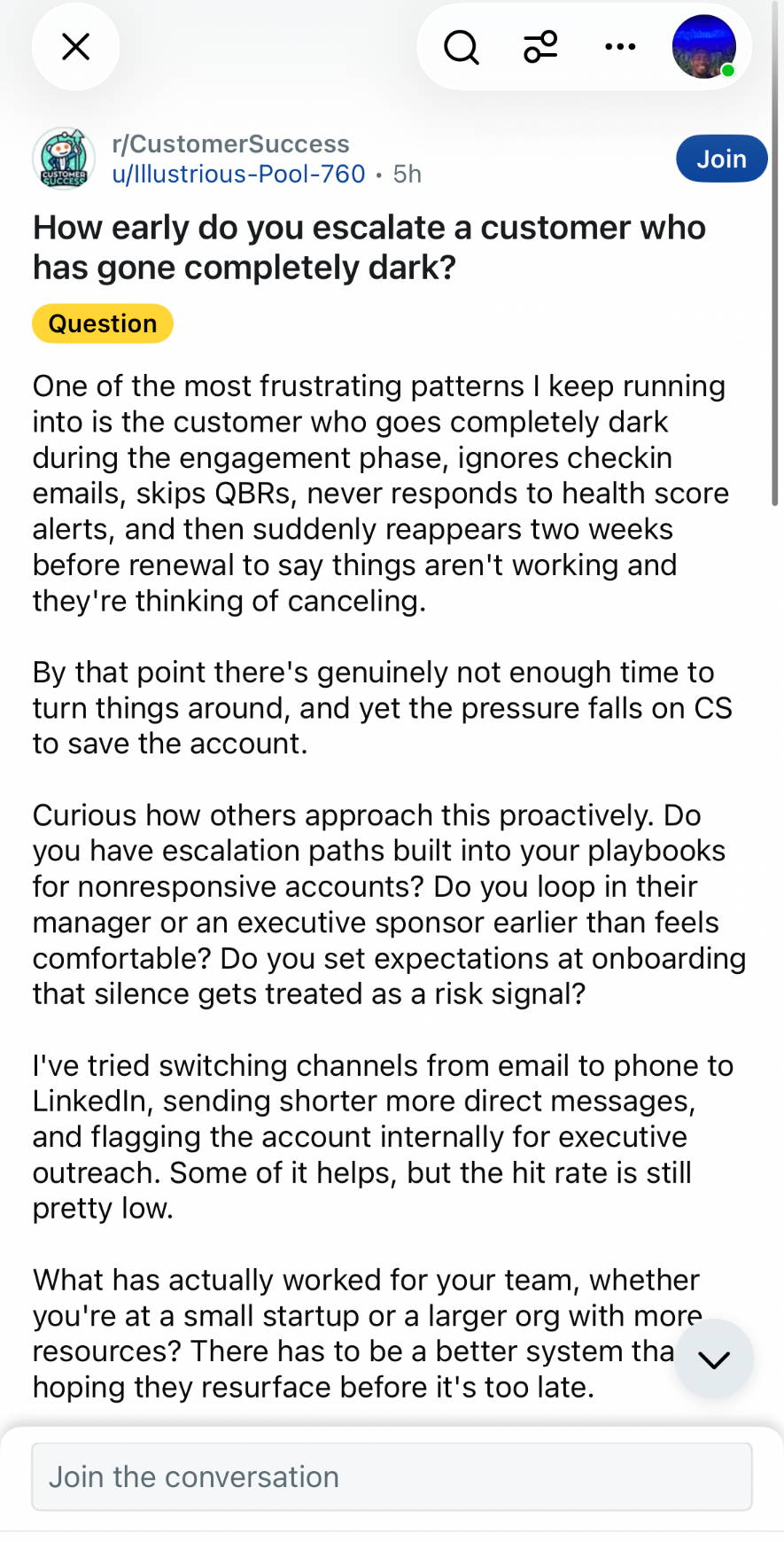
Source thread: Read the original r/CustomerSuccess discussion →
I jumped in with three accounts from my own book, all anonymised below, and the four-part framework I use to keep renewals alive. If you're tired of accounts going dark or getting blindsided at the finish line, this is the harsh reality of enterprise churn, and the framework to stop it.
Story 1: the "ghost" account that required long-distance hustle
"One client (law firm) didn't respond to any emails when I took over the account from a different AM. I'd call their office a few times and that would typically trigger a note that he responded to every time. I'm in Ireland and they're in LA btw. And ya boy don't got long distance like that. But it had to be done."
The real-world proof
None of these stories are hypothetical. They all happened to me. This one was a US law firm with a stretched team that treated the platform as a basic keyword-ranking tool they only checked when calls dipped. They weren't logging in to use advanced features. They were simply too busy.
How we turned it around: instead of waiting for them to ignore another email, I leaned into my agency background and proactively did the strategic work on their behalf, then walked them through it on a short call. Taking the heavy lifting off their plate turned a silent account into an aligned partner.
Story 2: why "close engagement" is a false safety net
"One client (massive global manufacturer) was a product champion. We had regular monthly syncs. But then their renewal request got denied when it came renewal time. Poof. Contract gone just like that. Sharing this story because sometimes even close engagement won't save you. What we needed was to feed a commercially strong narrative for SEO to executives signing the contracts."
The real-world proof
The SEO manager at a global engineering software vendor was a brilliant product champion. Deep on the platform, openly called out when internal stakeholders chased "lunatic level" goals (like trying to jump from 0% to 10% share of voice without a content strategy).
But that same champion had to build a massive internal marketing presentation just to justify organic search's value to his executive leadership. His own words:
"Organic search is the second leading channel in traffic, form submissions, and revenue... but AI isn't even a blip on our traffic radar... We need to care about the actual conversion elements."
But I guess it wasn't enough to support an enterprise level search intelligence platform. If we as account managers only talk about technical data or platform widgets, we leave our champions weaponless when they stand before the budget-signers. We have to arm them with a commercial narrative (traffic, conversions, revenue protection) that executives actually care about.
Think you'd spot the executive narrative gap before renewal hits? Read the Room scores how well you decode what a client actually means.
Try Read the Room →Story 3: the flashing red light of a departed champion
"Another client (regional travel & tourism), soon as PoC left the company I flagged the account. You're not safe until you get that new PoC in-app themselves or signing in a junior member. That didn't happen. The new PoC attended one QBR then went dark. But we were ready for it and were successfully multi-threaded with procurement."
The real-world proof
We saw a variation of this on a B2C travel platform overseeing ground travel and holidays. A backup contact had to step in and cover a platform walkthrough because the primary contact was away and other team members couldn't make it.
When leadership or personnel shifts occur, an account instantly enters a high-risk zone. New leaders bring new questions, and if the organisation suffers from data immaturity, they fall into endless cycles of explaining past limitations to a rotating door of executives. If you aren't multi-threaded across procurement, product marketing and digital leadership early, you will get dropped the moment your primary champion leaves the building.
The 4-step framework to prevent enterprise churn
To keep clients from going dark and to bulletproof your renewals, you have to operationalise your communication strategy. Four tactics I live by:
- 1Embed your work into core operations
Your service cannot sit on the "nice-to-have" shelf. Tie it directly to initiatives the business is already funding (a replatform, a market launch, a brand refresh, a CRM migration, a regional expansion). When your work is woven into something the company has already committed budget and headcount to, cancelling you means slowing that project down. That's a much harder decision at renewal time.
- 2Make sure other people know you, like you, and trust you
Don't put all your eggs in one champion's basket. Build relationships across functions, reaching beyond your buyer's team. Adjacent teams (product marketing, paid media, analytics, procurement) all have something to gain from what you do. When your champion goes on leave, gets promoted out, or leaves the company, you want at least three other people in the org who can already speak to your value.
- 3Make onboarding and ROI reporting frictionless
If a new PoC takes over, they shouldn't have to climb a mountain to see your value. Hand them a short, plain-language summary of what's been done, what's working, and what's next. Automate the recurring reporting so the answer to "what am I getting for this?" is one click away, not a half-day exercise. The goal is zero time-to-value for the next person in the seat.
- 4Create a flawless legacy handoff document
When an executive asks "why are we spending money on this?", the proof has to be instantly accessible. Keep a living document that captures the history of the account, the decisions made, the metrics that matter, and the commercial impact in dollars (or the closest proxy you have). You aren't just defending a contract. You're defending an ongoing business case that has to survive turnover on their side and yours.
Take the next step
Client retention isn't an engineering problem or a product problem. It's a strategic communications problem. I built SEO Comms Clinic to help account managers, digital marketers and customer-success professionals navigate exactly these high-stakes client scenarios.
See how sharp your client read is. Drop in a 30-second client message and get instant FREDA scoring on what they're really saying.
Try Read the Room →FAQ
Why do enterprise renewals get denied even when engagement looks good?
Because the people you're engaged with usually aren't the people signing the contract. Friendly monthly syncs with your day-to-day PoC don't reach the budget-signing executive. If your champion can't translate your work into a commercial narrative their leadership cares about (traffic, conversions, revenue protection), the renewal dies in a room you were never in.
How early should I escalate an account that's gone completely dark?
Immediately. Silence is the signal itself. Don't wait for a missed QBR or a slipped renewal date. The moment a PoC stops replying to two consecutive touchpoints, escalate by changing channel (call instead of email), changing message (commercial outcome instead of platform usage), and adding a second contact in the org. Waiting to be polite is how accounts die.
What should I do when my champion leaves the account?
Treat it as a red-alert moment. Until the new PoC is in-app themselves or has nominated a junior to take over day-to-day work, the account is at risk. Re-onboard them with a zero-friction summary, get on a call inside two weeks, and make sure you're already multi-threaded into procurement, product marketing, or digital leadership so you're not depending on a single replacement contact.
How do I multi-thread an enterprise account properly?
Build relationships outside your immediate buyer. Talk to product marketing about personas, to the paid-ads team about search-volume intelligence, to data scientists about tracking discrepancies, and to procurement before renewal season starts. The goal: when your primary champion leaves, at least three other people in the org already know what your work does for them.
How do I communicate SEO value to executives who don't care about rankings?
Translate everything into the language of the finance team: revenue contributed, pipeline influenced, customer acquisition cost vs. paid channels, and what gets lost if the budget is cut by 50%. Executives don't buy rankings or pillar pages. They buy revenue protection. Your job is to arm your champion with a one-page commercial narrative they can walk into the CFO's office and defend without you.