AI search is in its awkward adolescence
Handled 19 enterprise SEO renewals worth $450K TCV. All 19 renewed. Built FREDA from what worked.
More about the framework →It's a big week. If you're headed to BrightonSEO, here's a lens that you should bring with you: AI search is in its awkward adolescence.
Remember being a teenager trying to prove yourself while everybody questions you, figuring out what's right and wrong, where you fit, and who you want to become?
That's what AI search feels like to me right now.
I manage 50 enterprise accounts at Moz, and since May 2026 I've been collecting signals around AI search through SEO Comms Clinic. Those perspectives put me close to the questions businesses are asking and the changes happening around them. They also remind me how differently people can experience the same shift.
Some people are winning. Some people are watching the wins. And some are wondering whether there's a place for them in any of this.
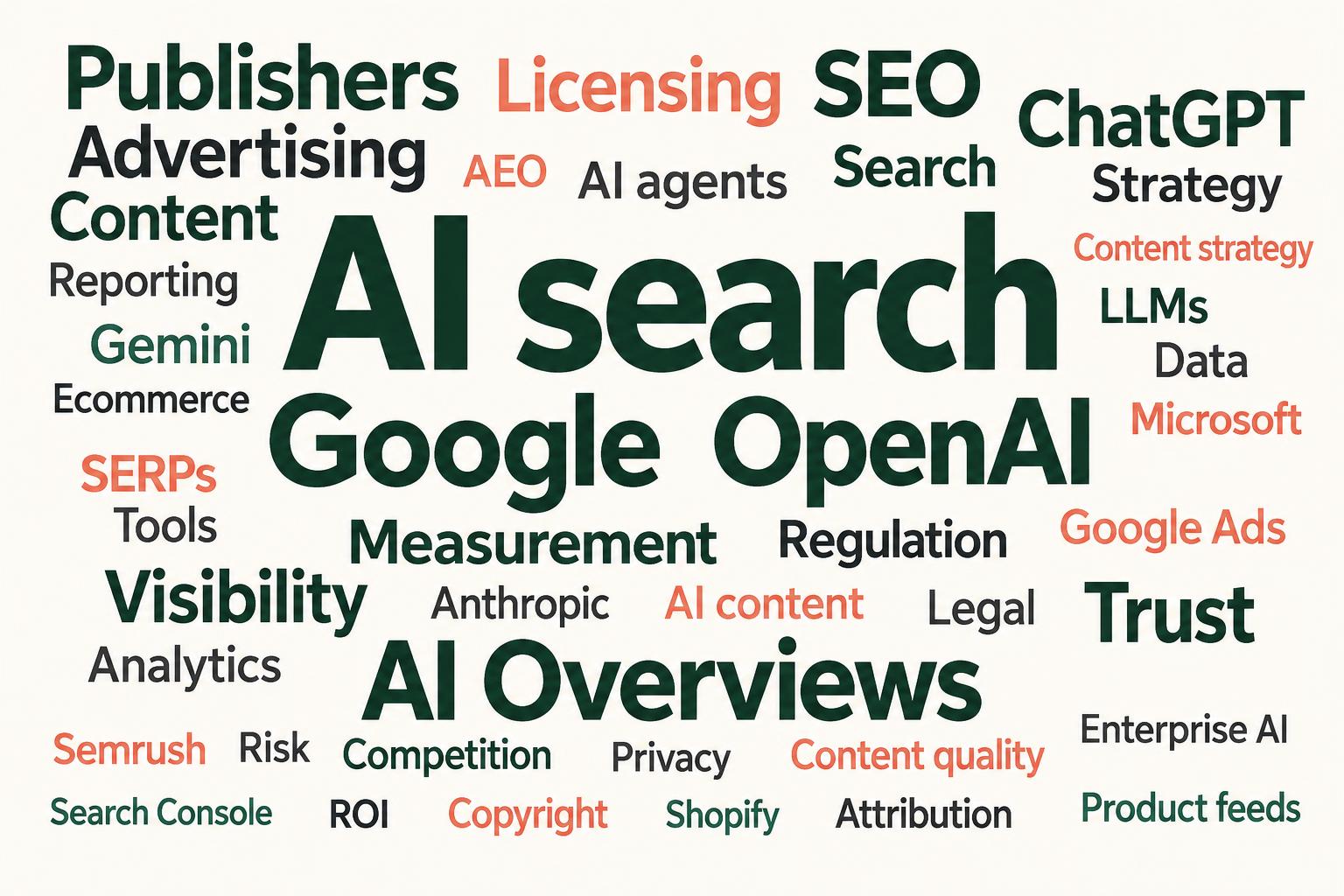
There's enough happening to pay attention
New products, companies, investment and publisher partnerships give us tangible reasons to take AI search seriously.
For example, OpenAI's partnerships with The Guardian and The Washington Post bring their journalism into ChatGPT responses.
- Amazon's AI shopping assistant gives customers product recommendations inside its shopping app and website.
- Prismic's integration with Peec AI brings AI visibility scores, share of voice and competitor benchmarks into its Page Builder.
Amazon: AI shopping assistant →
Prismic: Peec AI integration →
If you work in SEO or marketing, you need enough understanding to ask useful questions, make informed decisions and explain the implications to the people who depend on you.
We're experiencing different versions of the same industry
Depending on where you look, you'll hear very different accounts of AI search.
In online communities like Reddit, it's easy to come across frustration from people who feel their businesses and their discipline are being damaged. Their organic traffic got slashed. There's uncertainty about what comes next, and anger about how little control practitioners have over it.
Some people are winning. Others are watching the wins.
AI search can still feel like a game of who's who.
You see familiar names sharing experiments, building products and reporting results. If you're outside those circles, it can be difficult to work out what's transferable to your own business.
What resources did they have? How established was the brand? What did they change? What did they measure? How long did it take?
When someone links AI brand visibility to revenue, I want to understand the connection.
Was it a customer saying they found the business through ChatGPT? A tracked referral that converted? An increase in mentions alongside an increase in sales? Those observations tell us different things.
A brand mention, a visit, an enquiry and a sale are each useful signals. Understanding the relationship between them takes work.
That's where the conversation becomes a question of maturity.
Source your own truth signals
Conferences give us somewhere to work through this together.
Everyone comes with something they're seeing, experiencing or testing. We get to listen, compare experiences and ask questions that a screenshot of a result can't answer.
That's what I mean by sourcing your own truth signals: listening carefully enough to understand the evidence, then considering what it means in your context.

I'll be asking:
- What's relevant to my clients? Does this example resemble their audience, market, resources and buying journey?
- What metrics do I go by? Is the result being measured in a way that answers the business question I'm responsible for?
- What content tactics make sense? Can my team execute the approach, and does it serve the people we want to reach?
- What values do I share with the speaker? How do their standards around accuracy, transparency and responsibility shape their strategy?
That last question matters to me.
A person's definition of a good result, and what they're willing to do to achieve it, influences the advice they give.
You can hear a brilliant talk, respect the work, and decide the approach doesn't fit how you want to operate. You can also encounter an idea that challenges your assumptions and deserves a proper test.
Both require judgment.
A category built by us, not just for us
The awkward adolescence metaphor is my interpretation of this moment. It captures the combination of visible progress, uneven results and questions about identity that I'm seeing.
And if the category is growing up, we have a role in shaping what it grows into.
We do that by sharing failures alongside wins. By explaining how we measured a result. By asking better questions. By deciding which practices we're prepared to recommend to clients and which need more evidence.
That's the grown-up part: choosing what to believe, understanding why, and taking responsibility for how we act on it.
So at BrightonSEO, I'll be listening for progress I can understand, methods I can assess and people whose judgment I can learn from.
Some people are winning. Some people are watching the wins.
The opportunity this week is to make those wins more understandable, and help more of us decide what to do next.
That's how we build an AI search category built by us, not just for us.
What does "awkward adolescence" mean for AI search?
It's the combination of visible progress, uneven results and questions about identity. New products, investment and publisher partnerships give real reasons to take AI search seriously, while reported results vary widely between businesses.
How should I judge AI search case studies at conferences?
Ask what resources the team had, how established the brand was, what they changed, what they measured and how long it took. A brand mention, a visit, an enquiry and a sale each tell you something different.
What are "truth signals" in AI search?
Listening carefully enough to understand the evidence behind a claim, then considering what it means in your context, your clients' audience, market, resources and buying journey.
Why do values matter when choosing whose AI search advice to follow?
A person's definition of a good result, and what they're willing to do to achieve it, influences the advice they give. You can respect the work and still decide the approach doesn't fit how you want to operate.
The Adoption Curve tracks how AI search visibility is actually spreading, week by week, from reviewed signals.
See the Adoption Curve →Working on founder positioning, podcast placement, commercial partnerships or content strategy?
Discuss a project →